
Tales from the Edge of Memory – Managing the Pills
Managing the pills is a daily battle. In the beginning, it was even one of the arguments we used to convince her to leave her apartment. My brothers, Jean-Paul and Rock, would bring her medication every morning and every afternoon. But she insisted she wasn’t taking anything. She just didn’t remember.
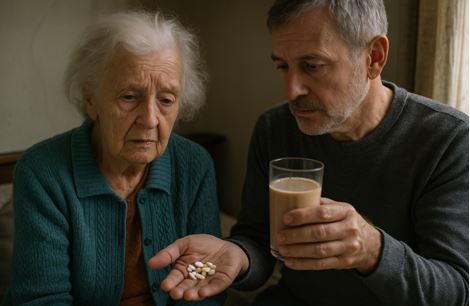
When she arrived to live with us, I set a routine: her morning pills always at the same time, and the evening ones too. In the morning, she takes seven pills. At first, she refused. Then, slowly, she got used to it. She would ask questions: “What’s this? Why am I taking that?” And then fewer and fewer questions. Today, when she comes out of the bathroom, I’m waiting for her: half a glass of Boost in one hand, her pills in the other. She knows they’re hers.
In the evening, I place her pills next to her plate. She takes them without a word. In the morning, she swallows them almost always in two gulps, without trouble. But there was one problem: she struggled to swallow the biggest ones. So I started splitting them in two. Which means she now has ten pills to swallow. Sometimes she drops one or two. I pick them up, and she takes them again immediately.
Last month, our dog Albert, our faithful miniature Australian Shepherd, passed away. At noon he was fine. By evening, he could barely move. We rushed him to the vet. He died there, of unknown cause. A comparison between the blood test results and my mother’s list of medications suggested he may have swallowed a pill she dropped that morning. We’re not 100% certain, and we never will be. But the probabilities are there.
And that… is very hard to bear.
It’s very hard to live with the idea that my mother’s presence — what she forgets, what she drops, what we don’t see in time — may have cost Albert his life. That gentle, loyal companion who was always lying somewhere near her. That dog who, in his own way, journeyed with her as she declined, and who loved her unconditionally. It’s a silent sorrow, but a constant one. A small wound that never fully closes.
Since then, there is no question of taking risks. We now have a new dog, Oslo, a tiny and curious little Biewer Terrier, and two cats. Medication time is now strictly supervised. I’ve tried everything: crushing the pills, mixing them into yogurt, applesauce, juice… Nothing works perfectly. When I crush them, she doesn’t eat everything. When I give them whole, she sometimes chokes. When I split them, there are too many, and she drops them.
So I refined my technique: I give her the six biggest first, while she’s focused and drinking her Boost. Then the four smaller ones, because those are the ones she most often dropped… and maybe the one that cost Albert his life.
She’s now so used to taking her pills that the other night, at supper, while I went to get a glass from the cupboard, I came back to the table… and saw her holding my pill organizer! Mine, the one I had left on the counter. She had already swallowed one pill. I said:
— “Mom, those are my pills for diabetes!”
She looked at me, surprised, and spat out the pill while laughing.
Reflection
The disease steals memory, but not reflexes. My mother has integrated this routine so deeply that even an unfamiliar pillbox fits into her daily logic. But that little moment reminded me that vigilance never takes a day off.
With medication, every gesture requires attention. Because one mistake, as small as it seems, can have serious consequences. Living with Alzheimer’s means watching the pills as closely as the emotions, the forgetfulness, the hidden dangers in ordinary gestures. It means loving while staying alert.
And sometimes, it means living with a sorrow you don’t quite dare to name.
Claude Marceau
