Tales from the Edge of Memory: Washing the Disposable
This morning, around 8:30, Mom went to the bathroom. Nothing unusual… except that she stayed there a good five minutes — which, for her, is basically a feature-length film.
Usually, she goes in and out with the speed of a lightning bolt that forgot why it flashed. But this time, there was movement. Rustling. Packaging noises. A little sigh, a hesitation.
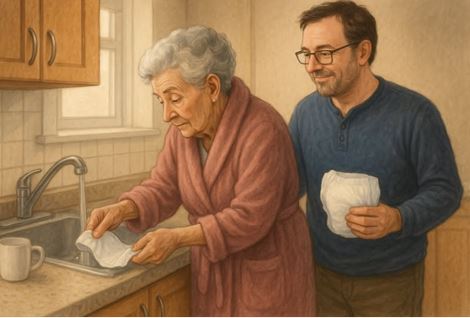
When she came out, she was holding her incontinence pad in her hand like a mitten lost in a storm. Arm extended, she walked slowly toward the kitchen, focused like a surgeon on a mission.
I kept an eye on her, already suspecting the next step: Mom often thinks the trash is under the sink — like it was in her old home in Normandin. That’s where she used to throw everything: papers, peels, secrets.
I approached gently.
“Mom, the garbage is on this side.”
And then…
She straightened herself up, offended, her dignity pricked just a little:
“I don’t have the right to wash my underwear?”
Before I could even respond, she turned on the faucet, vigorously scrubbed her imaginary cloth underwear, and applied herself to “getting the stain out.” A stain that no longer exists. Or maybe never did.
I stood there, half surprised, half admiring. Admiring her determination. This gesture of a woman who still wants to “take care of her laundry.” A reflex that survives everything — even the disease.
I tried a gentle explanation:
“Mom, it’s a disposable pad… you’re supposed to throw it away.”
She shot me a hard look. The same one she gave us when we refused to finish our vegetables in the 1970s.
“No, no, I know my underwear. I just want to get the stain out.”
And she scrubbed. Determined. Meticulous. Almost peaceful.
Okay. Plan B.
I went to get her a new pad. Came back. Handed it to her as calmly as possible.
She got upset again, her voice trembling with confusion:
“But what am I doing wrong?”
And that’s when it hit me.
She doesn’t understand that the world has changed around her. That this pad is not washable underwear. That the thing she holds in her hands deserves neither tenderness nor laundry soap. But in her mind, it’s underwear. Her underwear. And underwear gets washed.
I took a deep breath.
“You’re not doing anything wrong, Mom. Give me your underwear, I’ll put it in the wash. Put this one on instead.”
She handed it to me. Thanking me. With a small sigh of relief.
She went to put on the new one, a bit calmer. She believed she had “saved her dignity.”
And I stayed there, holding a damp disposable pad, shaken by the absurd beauty of the moment.
It isn’t logical. It isn’t clean. It isn’t “the right way.” But it’s human. Deeply human.
She no longer sees the difference between laundry and disposable products. But she still sees what dignity is. Modesty. The desire to stay clean. To be a woman who respects herself, even when memory slips away.
I watched her walk away. Her back a little bent, but her step proud.
And I thought:
Love, sometimes, smells like urine.
And it doesn’t even bother me.
Reflection
That morning, I understood that Alzheimer’s doesn’t destroy everything. It scrambles gestures, confuses landmarks, but it sometimes leaves untouched what comes from the heart.
This deep desire to stay clean. This need to feel useful. This will to do things “properly.”
She no longer always knows where she is. She forgets my name. She asks me three times an hour who lives here. But she wants to wash her underwear. Because that is the gesture of a strong woman. A dignified mother. From a time when you folded the laundry before you folded your knees.
And me, in the middle of all that, I discover that real love isn’t always expressed with flowers — or even with words.
Sometimes, it speaks in silence, while holding a soiled pad…
and still finding something beautiful in it.
— Claude Marceau
